A website for all things Mr. Spong

Tag: journal

Reflecting on my learning in CONT 951 through Module 4

2026.10.24

Summary of key learning throughout Module 4

Many technologies can enhance students’ learning experiences. AR and VR can be used to help students create prototypes or to provide new opportunities for simulation-based labs. 3D printers can be used by teachers and students to create inexpensive models of science phenomena, such as molecular structures, to help students gain an intuition for abstract concepts (Trujilo-Cayado, 2023)

Artificial Intelligence continues to be a source of worry and confusion for educators. I still feel it is unclear how best to use AI in the classroom; however, signs point to a need to help students develop technological competency with AI so they use it as a tool rather than a crutch. One thing is clear: AI is already in our classrooms, and educators need to consider their expectations for students.

Gamification can help students gain an appreciation that mistakes can be corrected, and need to be made in order to learn (Nilüfer, 2023). It can positively impact “motivation-related components” of student learning. Open learning environments are popular ways for students to learn skills without high upfront costs, and are often gamified to retain students.

The “maker movement” can promote curiosity, open-ended exploration, and self-directed learning for students (Krakower, 2016)

Connections to my current practice

I currently use simulations during lessons to engage students and encourage them to come up with hypotheses for various science concepts. I use Kahoots, Blookets, and other games to gamify my classroom. Sometimes, I use games like Wordle, Globle, and Blossom to play games without a STEM objective to encourage class collaboration and culture-building.

New Ideas I have incorporated into my practice since Module 1

Since Module 1, I have incorporated design thinking in my everyday life to help develop lessons, unit plans, and apartment upgrades. I have been working on considering the end user, creating prototypes, and iterating on the prototypes, specifically for building a side table for my apartment.

I have looked for opportunities to promote design thinking with students during my teaching-on-call work.

New ideas I would like to try incorporating into my practice

I would like to try incorporating 3D printing into my practice. First I would like to make my first prints using open-source models, then I would like to try to create something myself. Hopefully I can gain enough proficiency in 3D printing to encourage students to use the 3D printers available to them at the schools I work.

How I will improve collaboration and communication in my classroom

I will have students complete a “collaboration compass,” and use their compass results to help create groups. I will co-create group expectations with the students to provide clear guidelines for inclusive collaboration.

How I will improve collaboration and communication in my current role

I will reach out to teachers in different science, mathematics, arts, and engineering classes to create collaborative projects that span competencies in both courses. I will improve my communication skills by practicing active listening as outlined by Treasure’s video 5 Ways to Listen Better

Revisiting areas of growth from Module 1

In Module 1, I created a personal growth plan with two areas of growth to incorporate STEM principles in my practice.

First, I wanted to learn ways to incorporate STEM principles in senior sciences, with the specific questions of “How can I collaborate with teachers from other disciplines to help students find connections between them?” and “What technologies can I learn about that could give students something to be excited about?”

I think that Module 3 and Module 4 helped me answer these questions. In Module 3, I learned that active listening and communication skills can help me collaborate with other teachers and create collaborative classrooms with project-based learning intentions. I think applying project-based learning can help connect STEM subjects. In Module 4, we discussed different technologies students can use to get excited about learning STEM. I think 3D printing materials that help students build intuition for abstract ideas in physical 3D space have a lot of potential for creating rich learning experiences. I also think that utilizing 3D CAD software and simple AR applications can help students visualize and prototype for project-based learning activities.

Second, I wanted to consider how I can reduce racial and gender bias in my classrooms by using the Mindful STOP method. I have become more proficient in using the mindful STOP method to tackle challenges that have come up in classrooms.

Moving forward, I would like to learn how to assess project-based learning equitably. I would also like to learn how to encourage students to think critically about technology’s social and environmental implications.

Links, artifacts, and future articles of interest

Educational Technology Mindmap

https://www.mindmeister.com/app/map/4108157618?t=gFuh2WpH4k

Technology I already use in the classroom

Explanation of the Technology1. PhET – Changes in matter simulation 


This interactive simulation uses moving “balls” to represent molecules in different states of matter. Users can increase and decrease pressure, heat, and change the molecule type.  

2. Vernier Motion Sensors 


Vernier motion sensors measure position, velocity, and acceleration of moving objects. The data is recorded into a free browser-based program that organizes the data into interactive graphs.
How I Use the Technology1. PhET – Changes in matter simulation 


I use this simulation across all grades to explain concepts like changes in state, kinetic molecular theory, and pressure. I ask students to predict what will happen when one of the variables is changed. I will also ask students to tell me which variable to change to get them more involved. 

2. Vernier Motion Sensors 


In Physics 11, students use textbooks to raise one end of their desk, creating a slope for a cart to roll down. They use a chromebook and Vernier Motion Sensor to record the motion of the cart as it rolls down the desk. Students analyze the data to make predictions and gain intuition for acceleration, velocity, and distance. My favourite is the small fact that the “integral” is the “area under a graph.”
An image & a Link to the Tool  (if web-based)https://phet.colorado.edu/sims/html/states-of-matter-basics/latest/states-of-matter-basics_en.html 

https://www.vernier.com/product/go-direct-motion-detector/

Improving Group Work in STEM courses presentation by myself and Kelsey Harpman

Some of the articles I learned from throughout the unit

Al-Ansi, A. M., Jaboob, M., Garad, A., & Al-Ansi, A. (2023). Analyzing Augmented Reality (AR) and Virtual Reality (VR) recent development in Education. Social Sciences & Humanities Open, 8(1), 100532. https://doi.org/10.1016/j.ssaho.2023.100532

Fleming, L., & Krakower, B. (2016, July 19). Makerspaces and equal access to learning. Edutopia. https://www.edutopia.org/blog/makerspaces-equal-access-to-learning-laura-fleming-billy-krakower

Said, S. (2023, August 17). How to motivate students to work in collaborative teams. Edutopia. https://www.edutopia.org/article/collaborative-group-learning-high-school

Sharma, S. (2023, August 14). Guiding students to assess the merits of Artificial Intelligence Tools. Edutopia. https://www.edutopia.org/article/teaching-students-use-ai-tools/

Stehle, S. M., & Peters-Burton, E. E. (2019). Developing student 21st Century skills in selected exemplary inclusive STEM high schools. International Journal of STEM Education, 6(1). https://doi.org/10.1186/s40594-019-0192-1

Treasure, J. (2011, July 29). 5 Ways to Listen Better. YouTube. https://www.youtube.com/watch?v=cSohjlYQI2A

Zeybek, N., & Saygı, E. (2023). Gamification in education: Why, where, when, and how?—a systematic review. Games and Culture, 19(2), 237–264. https://doi.org/10.1177/15554120231158625

Technology and the Personal Social Competency

2026.10.24

CONT 951 – Module 4 – Technology and Personal and Social Competency

How can you evaluate the reliability and credibility of online information for STEM-related research and projects?

First, I can evaluate whether the source is an institution, blog, or media. Generally, I trust institutional sources and traditional media as more reliable than blog posts. I can use spelling, formatting, content, and syntax as potential indicators of a source’s quality. I can use Google Search and AI tools to gather evidence of an online source’s credibility.

How do you recognize the impact of technology on your personal well-being and social relationships?

I recognize technology’s impact on my personal well-being and social relationships by staying mindful of my screen time. I find that I am susceptible to the infinite-scroll mechanics of most social media platforms. I still feel I get value and learning from YouTube; however, I am finding myself on “YouTube Shorts” more often, which can lead to lost hours. I recognize that I feel emotionally drained after long sessions of scrolling YouTube Shorts.

Because of the likelihood I will fall into scrolling-induced black holes, I do not use social media like Instagram, Snapchat, Facebook, X, TikTok, etc. without an explicit goal in mind. This means I check social media only every few months to catch up on missed messages or for research.

How do you help students navigate technological advancements?

I think students should be led to make their own decisions about the potential impacts of technological advancements. However, students may not have the media literacy to identify and seek reliable sources from multiple perspectives. Therefore, I play devil’s advocate with students and ask neutral questions to encourage them to consider multiple perspectives.

“I can…” Statements for the Personal and Social Competency regarding technological advancements

  • I can evaluate the effects of using technology on my well-being.
  • I can listen to perspectives from multiple sources to evaluate technology’s impact in personal, social, and utility-based contexts.
  • I can develop strategies to solve technology-related problems.
  • I can advocate for inclusive behaviour online.

A 2026 Perspective on AI in Education

2026.10.22

CONT 951 – Module 4 – AI Generated Media

Triangle Thoughts – 3 Incorporations

  1. Physics & Math

Having students solve problems, then evaluate the relative quality of answers from various LLM’s (Sharma, 2023).

I have found that LLMs are useful for explaining concepts in ways that tailor to specific language needs.

Use LLMs to explicitly solve problems incorrectly so students can determine what went wrong.

220
Students will have to learn how to fix AI outputs!

Concepts from the articles that Square with my beliefs

I believe the doom-and-bloom dichotomy of AI is overblown, as teachers stated in Waxman’s (2023) article. I think technology and society will settle into some equilibrium over time. I predict this equilibrium will take about a decade to settle, despite the rapid advances in AI technology.

I think that AI can be used as a tool to develop critical thinking skills as opposed to hindering them, if used and taught responsibly (Sharma, 2023). If students are used to creating and designing projects, they will have proficiency with self-directed learning and idea creation. AI can be a great tool to help get started with projects.

299
Allowing AI in our society is a balancing act!

Circling Thoughts

Something that worries me is that AI training data is inherently skewed toward Western, White, Cis-gendered, Male perspectives, thus potentially perpetuating social biases and inequalities (Waxman, 2023). I start to feel like I’m spiralling a bit when I consider recent political shifts away from DEI initiatives, incentives for anti-inclusion across economic and social spheres, and the apparent political capture of Big Tech in general. I am concerned about how these spheres will influence education

I will need to learn more about the kinds of “thinking practices” and competencies that teachers are able to help students develop using AI.

198
These kinds of discussions can feel like too much sometimes. Especially given that it’s nearly every day something AI related is in the news.

Citations

Khan, S. (2023). Sal Khan: How ai could save (not destroy) education. Sal Khan: How AI could save (not destroy) education | TED Talk. https://www.ted.com/talks/sal_khan_how_ai_could_save_not_destroy_education?hasSummary=true

Sharma, S. (2023, August 14). Guiding students to assess the merits of Artificial Intelligence Tools. Edutopia. https://www.edutopia.org/article/teaching-students-use-ai-tools/

Waxman, O. B. (2023, August 8). How teachers are using AI like CHATGPT in schools. Time. https://time.com/6300950/ai-schools-chatgpt-teachers/

Makerspaces for Inclusivity

2026.10.20

CONT 951 – Module 4 – Maker Movement for Inclusivity

I have been a member of a local makerspace for the past two years. My local makerspace provides access to tools for woodworking, metalworking, sewing, CAD, robotics, and electronics. Living in an apartment without space for these tools, I used the makerspace to learn to mill and process wood and to create custom desks, side tables, and shelves for my space.

The makerspace’s inherent designer- and maker-oriented culture encourages an inclusive atmosphere. I spent a lot of time speaking with experienced makers who were curious about my work and provided inspiration for my own. I could not have built my desk without the help of the makers and volunteers at the space.

Markerspaces empower individuals by providing an opportunity to design, create, and execute self-directed projects with community support. I feel empowered because I can now create custom-made furniture to meet my exact specifications while learning new skills (and saving money!)

While building my desk, I made many mistakes, which show up as wide glue lines, bumpy transitions, planar marks, and leftover knots. Occasionally, I consider rebuilding the desk; however, I have grown to appreciate its character. Every mistake chronicles the story of my learning.

I believe makerspaces give students the opportunity to create and design projects that are fulfilling to them. Along the way, they develop proficiency in resilience, self-reliance, and cooperation that are difficult to emulate in a traditional classroom environment.

Citations

Fleming, L., & Krakower, B. (2016, July 19). Makerspaces and equal access to learning. Edutopia. https://www.edutopia.org/blog/makerspaces-equal-access-to-learning-laura-fleming-billy-krakower/

The Revised Bloom’s Taxonomy

2026.10.16

CONT 961 – What is a revised Bloom’s Taxonomy?

The revised Bloom’s Taxonomy views knowledge acquisition as an intersection of a “knowledge dimension” and a “cognitive process dimension.” Learning verbs from Bloom’s Taxonomy commonly referred to in the BC Curricular competency documents such as “remember, understand, apply, etc.” are considered the “Cognitive Process Dimension.” These verbs are then coupled with the “Knowledge Dimension,” which includes different types of knowledge a student can attain, such as factual, conceptual, procedural, and metacognitive knowledge.

With this system, Bloom’s Taxonomy becomes more useful, as it makes differences between cognitive levels clearer, more granular, and more continuous. It deepens our understanding of cognitive learning levels by allowing educators and students to pinpoint the steps students should take to demonstrate improvement.

See the revised Bloom’s Taxonomy below:

Module 1: Summary and Growth Plan

Areas of STEM I already incorporate in my practice

I’ve taught primarily Science 9 and Physics 11. In my Science 9 course, I try to have students relate between units. For instance, being able to name and recognize chemical formulas (chemistry) is useful when discussing the nitrogen cycle (ecology). I try to emphasize the context of how scientists developed scientific theories and how they didn’t have the technology we have now to research things.
I also like to emphasize that deeper scientific understanding can protect our society from misinformation of all kinds because it helps us develop a process for asking questions.

Two Specific Areas of Growth to Incorporate STEM Principles

First, I would like to learn ways to incorporate STEM principles in senior sciences like Physics. How can I collaborate with teachers from other disciplines to help students find connections between disciplines? What technologies can I learn about that could excite students (e.g., drones)?

Second, I would like to consider how I can reduce racial and gender bias in my classrooms. Being aware of my actions, using the Mindful STOP method, and reflecting on my classes at the end of the day will help me recognize my own biased actions.

What I hope to learn during this course

I would like to continue learning practical ways to incorporate STEM in the classroom.

How I will highlight everyday STEM in my current practice

I learned that teachers should get students excited about making connections between STEM disciplines. I can do this by: connecting STEM concepts to careers, which will be beneficial for students to see practical reasons to learn STEM education; utilizing infographics and STEM newsletters to provide easily digestible materials for students; and transitioning to a ‘facilitator’ as opposed to an ‘instructor.’ I can become a facilitator by implementing more hands-on learning activities.

Links, artifacts, and future articles of interest

Daily STEM News by Chris Woods. Podcasts, infographics, and more.

Facilitating Teaching and Learning across STEM Fields. Journal of STEM education : innovations and research. 2012, 13 (3).

Holder, A. M. (2018). Microaggressions: Workplace interventions. Microaggression Theory, 259–275. https://doi.org/10.1002/9781119466642.ch16

Kelley, T. R.; Knowles, J. G. A Conceptual Framework for Integrated STEM Education. International journal of STEM education 2016, 3 (1). https://doi.org/10.1186/s40594-016-0046-z.

Mossing, K. W., Collins, T. A., Newman, D. S., King, K. A., & Pollard, J. F. (2024). Race-conscious teacher coaching: Disrupting implicit bias and improving teachers’ relationships with black students. Journal of Educational and Psychological Consultation, 35(1), 114–141. https://doi.org/10.1080/10474412.2024.2359673

Stehle, S. M., & Peters-Burton, E. E. (2019). Developing student 21st Century skills in selected exemplary inclusive STEM high schools. International Journal of STEM Education, 6(1). https://doi.org/10.1186/s40594-019-0192-1

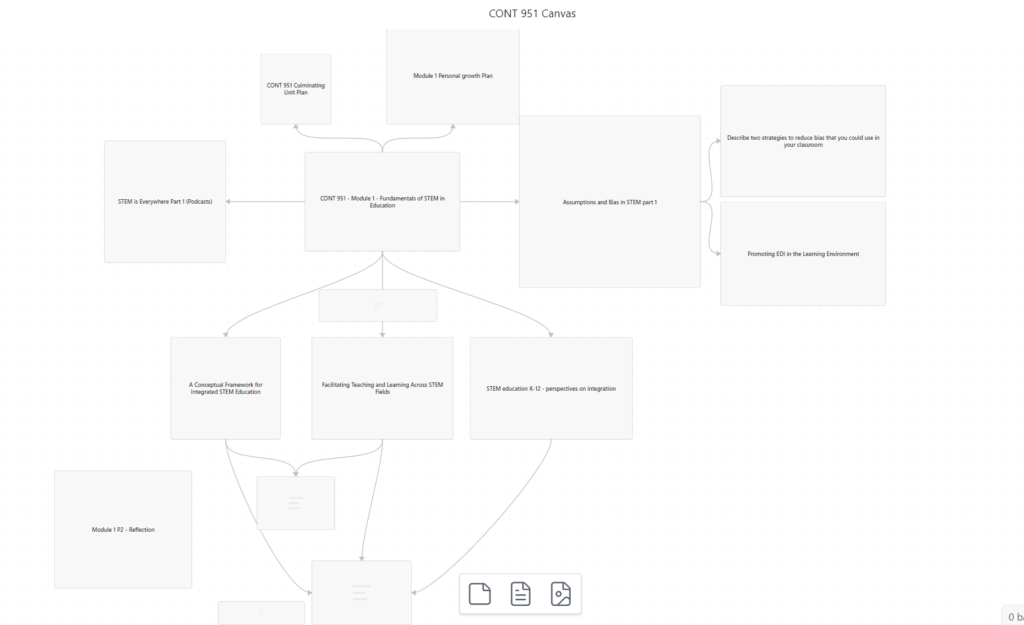
My ideas board for Module 1:

Reflecting on STEM Perspectives

2026.09.30

CONT 951 – Module 1 – STEM Perspectives Part 2

What are your major takeaways from the discussion?

To teach integrated STEM effectively, teachers must be confident in the subjects and concepts they wish to integrate. In my practice, I don’t have deep knowledge of Chemistry or Biology, which is a limiting factor. I think the best way to address the gaps in my understanding is to collaborate with other teachers in those fields.

Creating a safe environment for students to collaborate on problems is critical for success in a STEM environment.

What ideas resonate with you?

I think students will be more interested in learning science and math by implementing an integrated STEM curriculum because I feel excited as I look for ways to implement it in my practice.

Teaching students a system for considering the positive and negative effects of technology is becoming more relevant. I feel our society is constantly weighing the potential effects of artificial intelligence, and this conversation is complicated! If we develop fluency in considering the implications of technology, these conversations will be less daunting and more productive.

What areas do you want to know more about?

I would like to know more about how educators can implement an integrated curriculum when the current school system we work in is designed to be siloed. Schools like the “Pacific School of Innovation and Inquiry” use inquiry-based learning throughout the curriculum, so I feel it’s easier to implement a STEM approach in that setting.

How is this applicable to your current practice?

In Science 9, students are learning many branches of science throughout a single term. In this setting, I can see how concepts in electricity relate to concepts in chemistry, and from chemistry to biology, and biology to ecology. I wonder if I can utilize a STEM approach throughout the term in a way that is still accessible to students. As Kelly & Knowles (2016) discuss, students need a base of knowledge for an integrated STEM approach to be effective.

What are other thoughts, ideas and connections you have that will help you moving forward?

When designing curriculum, I will keep in the back of my mind, “How can I relate this to another field in STEM, utilize engineering design principles in my lesson, and make this relatable to my students?” I believe building this habit will help educators create more effective and interesting lessons.

Facilitating Flexible Thinking by Integrating STEM Concepts

2026.09.29

CONT 951 – Module 1 – STEM Perspectives Part 1

Creating a STEM environment.

Nurturing a holistic view of science requires careful consideration of the interconnected nature of science, technology, engineering, and mathematics (Ejiwale, 2012; Kelley & Knowles, 2016; Stehle, 2019). Integrating aspects of these four disciplines in student learning encourages mental flexibility and deepens knowledge. This flexibility and deep understanding are critical to thriving in a rapidly evolving global society.

To effectively teach students using integrated STEM concepts, an educator must first recognize the need for a “paradigm shift” from a traditional direct-instruction “teacher” to a “facilitator” role that guides students through challenges (Ejiwale, 2012; Kelley & Knowles, 2016). Next, a STEM educator needs to have deep knowledge of STEM concepts to address a wide variety of impromptu questions. Therefore, thorough preparation of course materials, course expectations, and environmental design is required so the educator can focus on the tasks at hand.

Stehle (2019) states that STEM activities should emphasize “real-world, problem-based learning.” Activities should pull from a bucket of skills typically “taught separately in each discipline.” Stehle, Ejiwale, and Kelley & Knowles agree that engineering design principles are what connect the skills and thought processes across disciplines.

With sufficient preparation, an educator promotes “an enabling learning environment for learners” (Ejiwale, 2012). Kelley & Knowles (2016) describe this learning environment as a “community of practice.”

Goals and challenges of STEM education, and some personal thoughts.

Students are more interested in science and math topics when learning concepts alongside real-world applications (Kelley & Knowles, 2016). By combining the four disciplines, students can make connections and deepen their understanding of the world around them, leading to increased interest in science-related careers (Ejiwale, 2012; Kelley & Knowles, 2016; Stehle, 2019).

This can be challenging, however, because students must have a base of conceptual understanding from each discipline before they can make connections between them (Kelley & Knowles, 2016). Therefore, educators must scaffold STEM learning and inquiry sufficiently to make this integrated approach accessible. Another barrier to an integrated STEM education is that educators “often feel underprepared because they are lacking authentic scientific research and inquiry experiences themselves” (Kelley & Knowles, 2016).

When I think about my educational experience, it was fairly traditional. Labs were more an assessment of a student’s ability to read and follow directions than an opportunity to ask questions, form hypotheses, and determine methods to test them. The recent practices I have observed perpetuate this rigid understanding of experimentation. A question posed as “Why do you think X happened?” has a right and a wrong answer, and if the student provides incorrect reasoning, they are docked marks. Emphasis is not placed on the thinking process, but rather on another form of regurgitation. I wonder how this problem could be addressed through practical STEM applications.

Teachers as economic vehicles.

Each article carries a theme that educators should strive to “produce citizens who are productive” (Ejiwale, 2012). Problems posed to students should include a business element so future employees have the skills employers need. I often feel conflicted about my job as an educator, which seems to primarily serve to produce citizens in the interests of capital. Or, as Kelley & Knowles (2016) frequently allude to on pages 1 & 2: to maintain American economic dominance. Perhaps an economic argument is required to gain funding from government programs.

Works Cited

Ejiwale, J. A. (2012). Facilitating Teaching and Learning Across STEM Fields. Journal of STEM Education, 13(3), 87–94.

Kelley, T. R., & Knowles, J. G. (2016). A conceptual framework for integrated STEM education. International Journal of STEM Education, 3(1). https://doi.org/10.1186/s40594-016-0046-z

Stehle, S. M., & Peters-Burton, E. E. (2019). Developing student 21st Century skills in selected exemplary inclusive STEM high schools. International Journal of STEM Education, 6(1). https://doi.org/10.1186/s40594-019-0192-1

Addressing Unconscious Bias in Schools

Journal 2026.09.29

CONT 961 – Module 1 – Establishing an EDI Learning Community

The Readings

The Harvard EdCast podcast episode titled “Unconscious Bias in Schools” and the online article “Strategies for Countering Unconscious Bias in the Classroom” discuss how educators need to be aware that they are not immune to acting prejudiced toward racialized students.

Educators likely want to provide quality instruction to all students, regardless of race (Anderson, 2019; Bowman, 2020). However, racist beliefs and habits are developed through societal “indoctrination” throughout one’s life. Learned racist biases need to be addressed in order to provide equitable instruction to all students.

Do the authors agree on strategies for teachers to reduce bias?

Both Anderson (2019) and Bowman (2020) agree that educators must:

  1. acknowledge that they have some bias toward racialized individuals;
  2. be willing to take risks and be uncomfortable to address said biases; and
  3. name their identity as a racialized person themselves.

Both authors employ the use of the term “unconscious bias” to describe racism. Sarah Fiarman explains that this verbiage helps make tackling racism more palatable for white educators, as people tend to retreat when there is an implication that they are racist (Anderson, 2019).

How does our recognition of bias help us to provide an equitable learning experience?

Recognizing bias helps educators provide an equitable learning experience by reducing the outward effects of racist conditioning perpetuated by society. During the Harvard EdCast podcast, Tracey Benson describes an experience with a teacher he hired as a principal. He observed that a group of black students in a classroom with a white female teacher were not participating during lessons, nor were they being called on by the teacher (Anderson, 2019). He noted that the teacher often had her back turned toward the group of black students and therefore did not see them throughout the lesson. A couple of days after informing the teacher of his observation, Benson returned to the classroom and noted that the teacher was calling on students to participate. By simply acknowledging the unconscious bias that the teacher exhibited, the black students began to receive a more equitable learning experience. This example shows that actively addressing potential unconscious bias is a huge first step in creating a more equitable learning environment.

In my own practice.

In my Grade 8 science class, I had a seating arrangement that changed every two weeks. One time, I thought that I had found the perfect seating arrangement. For a few days, the class was on task, collaborative, and engaged like I had never seen before. However, during the latter half of the first week, a student began to act out. This behaviour was uncharacteristic of the student. At first, I didn’t think much of it; I thought that maybe they were having a bad couple of days. By Friday, I could feel a tension whenever I interacted with this student. After class, I had asked them if something was wrong. The student became animated and said, to the effect of, “Mr. Spong, I’m constantly separated from my friends. Look at how you single me out on the other side of the class! Johnny, Jim, Jared, and Josh all sit in that corner. It’s unfair!”

For a moment, I was speechless.

Here I was, thinking the new seating plan was perfect, but actually a student felt I was treating them unfairly by keeping them isolated from their friends. I had no idea that this was a pattern across multiple seating arrangements. I apologized for my actions, assured the student that I was doing this accidentally, and changed the seating plan the next day.

By explicitly acknowledging my unconscious bias toward the student, I showed respect, dignity, and mutual concern, which in turn strengthened our relationship (Evans, 2022).

By asking questions, building relationships with all students, and being aware of others’ emotions, I learned about an unconscious bias I might not have noticed otherwise. This interaction changed how I view seating arrangements and made me much more careful.

Thank you for reading,

Jordan

Works Cited

Anderson, J. (2019, November 20). Unconscious bias in schools. Apple Podcasts. https://podcasts.apple.com/us/podcast/unconscious-bias-in-schools/id1062333296?i=1000457358698

Bowman, K. D., West, C., & Toner, M. (2020, August 4). Strategies for countering unconscious bias in the classroom. Association of International Educators (NAFSA). https://www.nafsa.org/ie-magazine/2020/8/4/strategies-countering-unconscious-bias-classroom

Evans, K., & Vaandering, D. (2022). The little book of restorative justice in education: Fostering responsibility, healing, and Hope in schools. Good Books.

© 2026 Mr. Spong's Blogs

Theme by Anders Noren — Up ↑