Areas of STEM I already incorporate in my practice
I’ve taught primarily Science 9 and Physics 11. In my Science 9 course, I try to have students relate between units. For instance, being able to name and recognize chemical formulas (chemistry) is useful when discussing the nitrogen cycle (ecology). I try to emphasize the context of how scientists developed scientific theories and how they didn’t have the technology we have now to research things.
I also like to emphasize that deeper scientific understanding can protect our society from misinformation of all kinds because it helps us develop a process for asking questions.
Two Specific Areas of Growth to Incorporate STEM Principles
First, I would like to learn ways to incorporate STEM principles in senior sciences like Physics. How can I collaborate with teachers from other disciplines to help students find connections between disciplines? What technologies can I learn about that could excite students (e.g., drones)?
Second, I would like to consider how I can reduce racial and gender bias in my classrooms. Being aware of my actions, using the Mindful STOP method, and reflecting on my classes at the end of the day will help me recognize my own biased actions.
What I hope to learn during this course
I would like to continue learning practical ways to incorporate STEM in the classroom.
How I will highlight everyday STEM in my current practice
I learned that teachers should get students excited about making connections between STEM disciplines. I can do this by: connecting STEM concepts to careers, which will be beneficial for students to see practical reasons to learn STEM education; utilizing infographics and STEM newsletters to provide easily digestible materials for students; and transitioning to a ‘facilitator’ as opposed to an ‘instructor.’ I can become a facilitator by implementing more hands-on learning activities.
Links, artifacts, and future articles of interest
Daily STEM News by Chris Woods. Podcasts, infographics, and more.
Facilitating Teaching and Learning across STEM Fields. Journal of STEM education : innovations and research. 2012, 13 (3).
Holder, A. M. (2018). Microaggressions: Workplace interventions. Microaggression Theory, 259–275. https://doi.org/10.1002/9781119466642.ch16
Kelley, T. R.; Knowles, J. G. A Conceptual Framework for Integrated STEM Education. International journal of STEM education 2016, 3 (1). https://doi.org/10.1186/s40594-016-0046-z.
Mossing, K. W., Collins, T. A., Newman, D. S., King, K. A., & Pollard, J. F. (2024). Race-conscious teacher coaching: Disrupting implicit bias and improving teachers’ relationships with black students. Journal of Educational and Psychological Consultation, 35(1), 114–141. https://doi.org/10.1080/10474412.2024.2359673
Stehle, S. M., & Peters-Burton, E. E. (2019). Developing student 21st Century skills in selected exemplary inclusive STEM high schools. International Journal of STEM Education, 6(1). https://doi.org/10.1186/s40594-019-0192-1
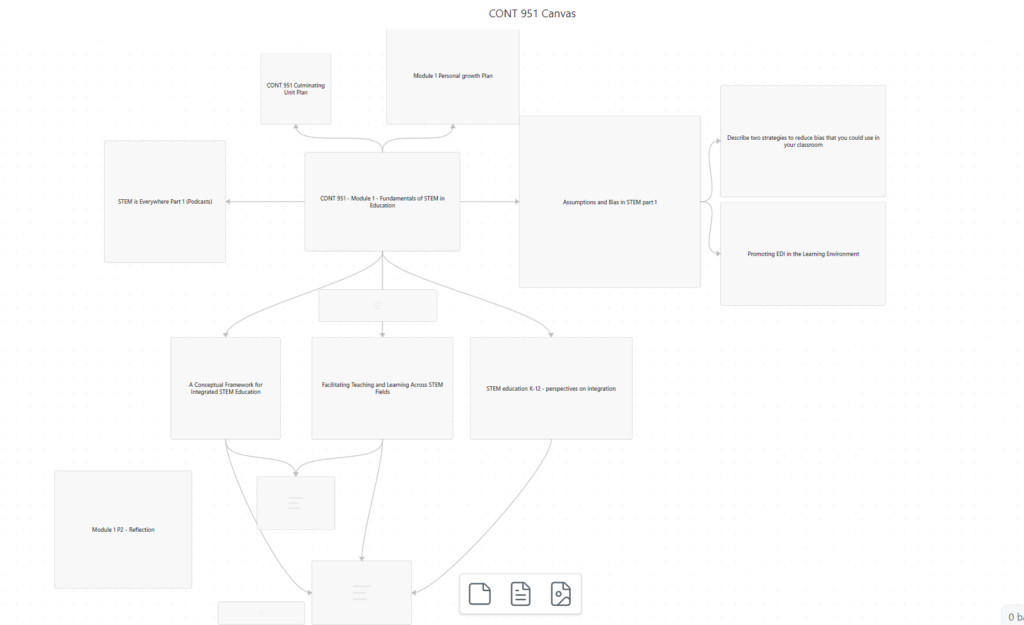
My ideas board for Module 1:
Leave a Reply
You must be logged in to post a comment.