Mr. Spong's Blogs

A website for all things Mr. Spong

Page 3 of 3

Technology Tutorial 1: File Curation Methods

Rationale

As teachers, we will be constantly collecting information from various sources and thus need to be intentional about storing and organizing our thoughts, files, and bookmarks.

As the administrator for a local house moving company, file organization is a high-priority subject. To date, I have been naming folders by year, and then nesting folders within them.
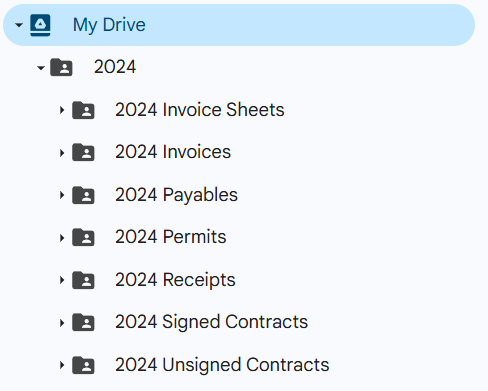
I chose this system because my intitial task was to organize the company files for the past 7 years. After I created a file-name convention this system worked great … until recently.

Notice that there is no way to view projects on their own. Any given client may have an unsigned contract, signed contract, multiple invoices, receipts, and permits to keep track of. I bold the word permit because this is the real kicker of the issue.

Why is file organization important to Mr. Spong?

To move a house, I need to receive two permits from the Ministry of Transportation for travelling on provincial highways and a permit from any municipality where we need to travel through their roads.1 For provincial permits, I need to receive approval signatures from four sources (hydro lines, cable lines, telephone lines, and district authorizations), and include a date range indicating when the move is projected to take place. With some recent legislation changes, I need to create schematics and detailed traffic management plans as well. Don’t ask me what happens when there is a delay.

If it seems like a lot to juggle – it is. And that’s just the province! Every municipality requires a different set of information. At the time of writing, we have about 4 moves on the go. This is unusually high, especially for the fall/winter months.
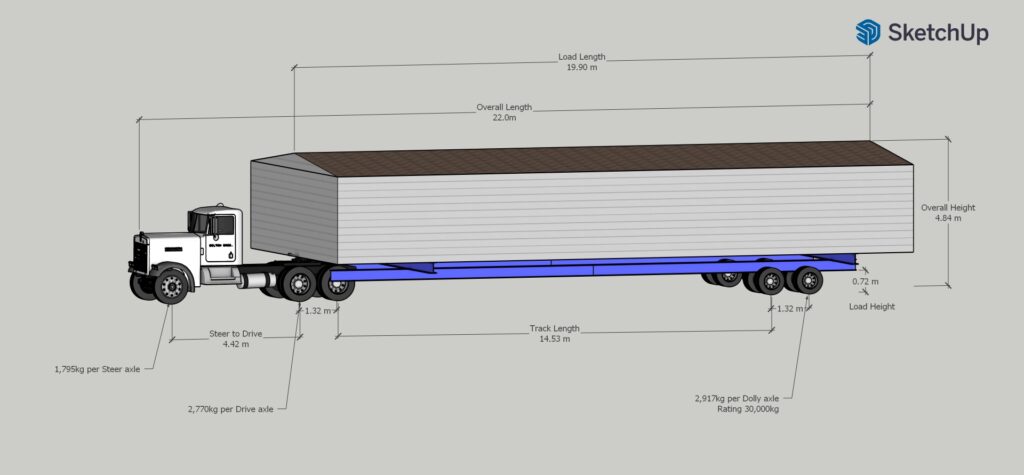
An example of a schematic diagram I made for a recent house move.

To do my job effectively, I’ve been looking for a file organization strategy that includes a way to group together current projects while maintaining some level of rigid organization. I also find myself referring back to old projects often because they provide a precedent for me to work off of.

There’s a lot going on in my files.

What is the point of this rambling?

Well, first it’s to vent a little bit. This can all be quite stressful at times.

Second is to illustrate that files today may not represent files tomorrow, and, perhaps more importantly, files rarely sit in one neat category. Our lives are nuanced and multidimensional; our files should represent this fact.

My Solution

I’ve taken a deep dive into the world of file management (and it’s associated gurus). Here is my method for organizing my files.

The PARA Method

PARA stands for “Projects, Areas of Responsibility, Resources, Archive”
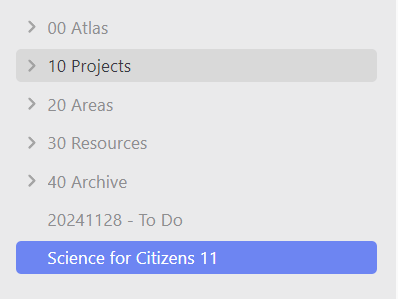
The Projects folder is for active projects.
I use the Areas of Responsibility folder, or Areas folder, as a place for my general files that are for areas that are responsibilities or hobbies that I have to attend to all the time. For instance, I have a School, work, people, sports, and health folder.

So far I mostly use the Resources folder for bookmarks. Saving things to folders of various areas of interest. I have Recipes, Literature, Bookmarks, Learning, Teaching, as my folders, but this is an area that will definitely change as I use the system more.

Lastly, the Archive folder is used as a dump folder for small ideas, pdf’s and pictures.

The Johnny Decimal System
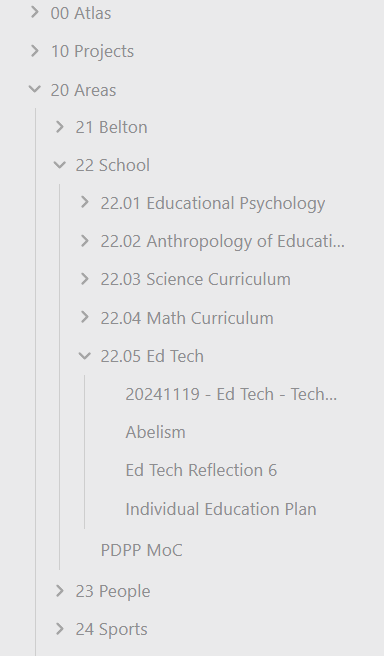
This system is a simple numerical system that uses decimals to create an ID for each of your folders and sub folders. The idea is that you use base-ten numbers for the ‘big idea’ folders, and then your first set of sub-folders is a single digit. Then you have a third subfolder set which is where you actually store your information. It’s easiest to explain using a screenshot.

So you can see that I have my PARA folders numbered as 00, 10, 20, 30 ,40. So, I have in my Areas folder, a School subfolder, and within that I have my courses numbered starting at 01, increasing by 0.01 for each new folder. So if I want to get to my Ed-Tech folder, I go to 20->22->22.05. ‘Belton’ is my work folder which has various permitting resources and notes from conversations I’ve had with customers.2
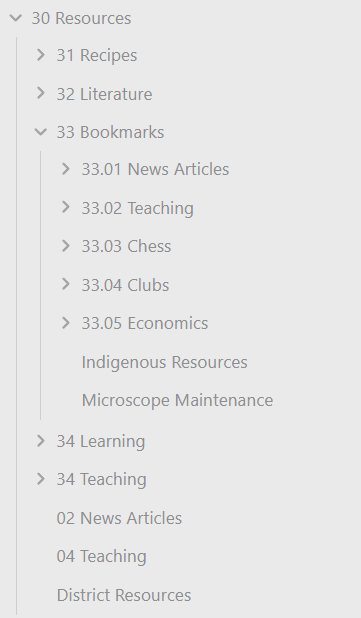
Here is another example in my resources folder for bookmarks. Again, this is a work in progress, but for now, it’s okay, and I can easily change it in the future to match what I feel is best.

This system keeps my files very ‘flat,’ i.e, my files are not more than 3 sub-folders deep. If I was to adopt a ‘deep’ file system (which is what I usually use), there can be sub-folders on sub-folders. Some of my work files are 4-5 subfolders deep, which can get very tedious.

Why should you care?

As teachers, it is important that we stay organized. We will collect information from conferences, professional days, one-off conversations with colleagues, and other sources. Without a system to organize our files, the likelihood of us losing that information to the void is high.

Additionally, if we don’t have a system that works for us, finding the files we know we have can be time-consuming, taking away brain power that we could be putting towards lesson plans or well-deserved break time.

There are many file organization strategies out there. I have opted to combine the PARA method and the Johnny Decimal System. I recommend that you research different file systems and decide for yourself. The best file system is one that works for you and your needs. Here are some other resources to get you started:

Building a Second Brain (PARA Method)

Johnny Decimal System

Sebastien Dubois – Personal Knowledge Management + Obsidian Info

8 Ways to improve your file management Strategy

Microsoft Best Practices for File Management

I hope you enjoyed reading and can use some of these tips in your practice.

Jordan

  1. I apply for permits called a CVSE 1052 and a CVSE 1049 ↩︎
  2. After writing, I realized that it isn’t the most illustrative to give my grand reason for adopting these file systems as work-related and then only show school stuff. I hope the point still gets across nicely. I have three folders in projects: 11 Work, 12 School, and 13 Personal. My subfolders in projects are organized by client/job name, so there is a confidentiality issue with screenshotting them. ↩︎
Reflection 5 – Inclusion in the BC Education System

What happened?

On November 18th 2024, BCEdAccess Society founder Tracy Humphreys and volunteer Kaori Lau discussed some of the systemic challenges that people living with physical, mental, or learning challenges face within the BC education system, what ableism is, and how BCEdAccess promotes equitable education practices.

BCEdAccess is a volunteer organization which seeks to “ensure equitable access to education for students with disabilities and complex learners in British Columbia.” They achieve this by providing resources to families, hosting webinars, community engagement programs, and more.

How do people living with disabilities receive asssistance?

First, a teacher, guardian, or the learner must recognize that the learner may need extra help due to an ongoing illness, mental health or physical challenge. Many students live with an undiagnosed challenge for years before it is recognized.

Next, the learner needs to apply for a psychoeducational assessment. This process can take years and cost families a significant amount of money. Tracy says that an evaluation for autism currently takes 2-3 years and costs roughly $4,000. Once they are assessed, they are assigned a “designation.”

A designation is a categorization based on the type of special education deemed appropriate for the disability. The Ministry of Education gives each category a set amount of funding to the District, which disperses these funds to schools. Abbotsford School District has posted these categorizations along with their funding amount.

What Now?

Tracy mentioned that her child didn’t receive a designation until after grade 12. She and her child decided it would be best to homeschool instead of attend school because they didn’t understand what worked for them in a learning environment. The school system therefore excluded the learner based on their disability, which was not detected/recognized until after their schooling had ended. This is very difficult for me to think about. I have member of my family who went through their schooling with a disability, but because we knew that they would have difficulties before entering school, they were able to receive a designation early on, and enjoyed their time in school because of it. The fact that this is not the case for most learners really breaks my heart.

This means that, as teachers, we need to be aware that learners may be deserving of extra help or a designation, but may not have access to it due to wait times or financial challenges. We must ensure that we promote an equitable and inclusive practice that utilizes classroom and pedagogical design that works for people with many challenges.

A One-Stop Shop for all Science Demonstrations and Simulations (Work in Progress)

You can view the project by clicking here (redirects to Google Slides).

Rationale

My driving question is, “How can I make science class exciting and accessible to students?” During my observations in science classes, I noticed that many students were disinterested in the topics presented.

I believe that excitement and accessibility are intertwined. If a student does not have the prerequisite skills to understand the presented concepts, they will likely become disinterested. Conversely, students who are uninterested in the material are unlikely to care about learning the pre-requisite material. It’s a vicious cycle.

I want to create a resource with a list of experiments/simulations for the different units of a Physics 11 class. Along with these experiment ideas could be a link to a video of a demonstration, as resources to conduct an experiment might not be available, or a student might miss the class. I would also like the resource to reference exciting content regarding the topic.

As of now, the project is available through Google Slides. I am questioning whether this will be its permanent home. The scope of the project is in a state of constant flux. I feel that my goals of including exciting content, many scientific disciplines, video examples, example probing questions, common conceptual misconceptions, etc. are a bit too lofty, but I’m happy that it has potential. I’m also happy that I know that it will be useful for some teachers, as it has already benefitted my tutoring.

Reflection 4: Pacific School of Innovation and Inquiry

On October 22, 2024, Pacific School of Innovation and Inquiry (PSII) founder and co-principle Jeff Hopkins spoke to our class about PSII, his vision for education, and how it all started.

PSII is an independent/private school located in the heart of Victoria, British Columbia. They use inquiry-based philosophy to deliver content to grades 9-12 students. This involves helping students develop multidisciplinary projects that act as vessels for curricular competencies. Hopkins provided stories of students in grade 9 fulfilling requirements for Physics 11 and 12 because they were interested in determining the velocity of a skier at Mount Washington. They use a checklist system to keep track of the competencies that a student has developed, and teachers suggest alterations to projects to ensure they are meeting the standards set by the BC curriculum.

Why Start PSII?

Hopkins states that administration and teachers know that direct instruction is not the optimal method for teaching students, but the education system does not allow for a dramatic shift in the way we teach. As a superintendent, this bothered Hopkins greatly. He refers to this phenomenon as the “knowing-doing gap,” when knowing what is right does not always mean that we are doing what is right.

There is another problem with implementing inquiry-based learning that goes beyond our current system limitation – it wouldn’t be ethical to change the educational ethos of an entire district without firm backing that it will work. So Hopkins decided to quit his superintendent job and open PSII.

What are the benefits?

Hopkins claims that there are far less behavioural challenges with students because they are excited to come to school and work on their personal projects.1

Other benefits include:

  • Individual needs are catered to.
  • Students are always working within their zone of proximal development.
  • Collaboration is encouraged and emphasized.
  • Students gain autonomy in their learning – what, why, and how they learn is up to them.
  • Learning is done in the context of a project, which leads to deeper and richer understanding.
  • Assessment is holistic and less artificial.
  • Students learn how to think for themselves, and think critically about their projects and analysis.

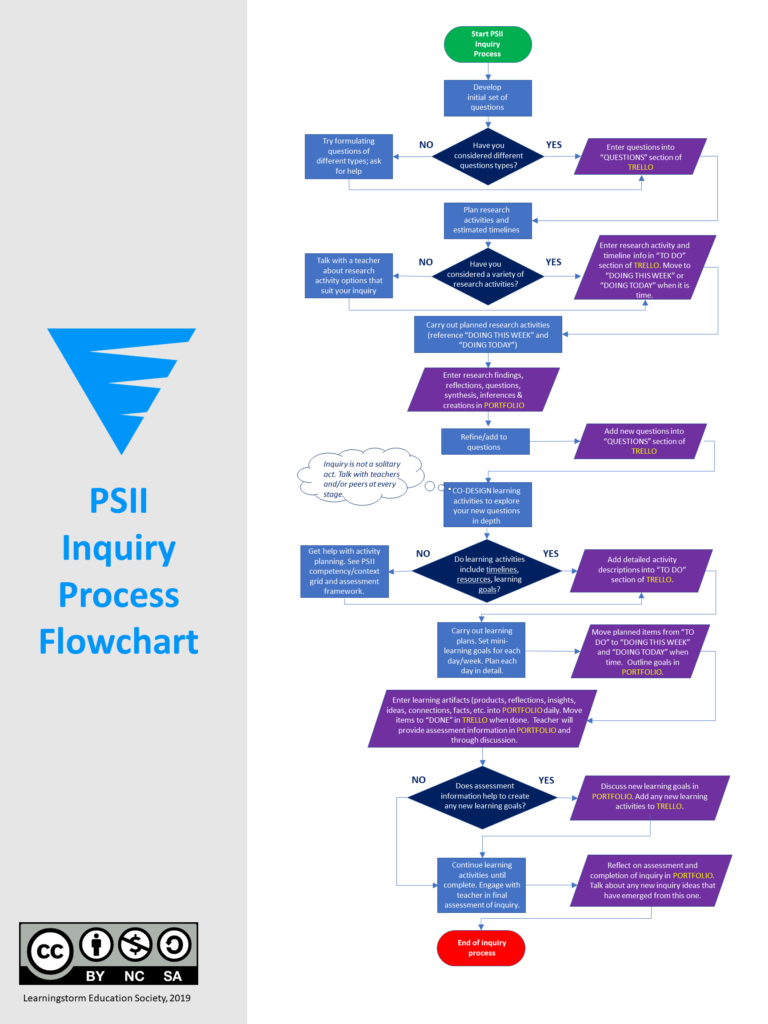
Below is a flowchart students use to develop their projects.

From the PSII Website

For more information, check out this video on PSII’s vision, goals, and methods via Vimeo:

Thank you,

Jordan

  1. I think it is important to note that this is a private school, so students and student parents are paying to be there, so it is possible that behavioural challenges and student engagement is affected by this. I trust that Hopkins is well-informed and not maliciously providing misleading information for personal gain. I just want to mention this fact. ↩︎

Reflection 3: Trevor Mackenzie & Inquiry Based Learning

On October 1st, 2024, Educational consultant, teacher, and author Trevor Mackenzie spoke to us about “Inquiry Based Learning.” We discussed classroom engagement, how to give feedback to students, and assessment strategies.

According to Trevor, classrooms with curious students experience better academic performance, increased attendance, reduced behavioural disturbances, and stronger peer-to-peer and student-to-teacher relationships.

“Curiosity is like a campfire; people naturally gravitate towards it.”

Trevor Mackenzie, October 1, 2024.

So how do teachers encourage curiosity? First, the teacher must model curiosity themselves. He states “curiosity is like a campfire; people naturally gravitate towards it.” Students need to be given the opportunity for “turn and talk” learning so that they can make assessments of their knowledge with peers, and ask questions that they may not otherwise put their hand up to ask. Utilizing ‘co-constructive’ activities; activities which allow students to figure things out for themselves, is a practical method to foster curiosity. Sitting with students and conversing with them about the topic can also increase attention and encourage the students to think about the topic.

These can be great opportunities to provide feedback to students. It is crucial to provide helpful feedback. Valuable feedback has three qualities: it needs to be kind, specific, and helpful. However, valuable feedback can be overlooked by a student if it is given next to a grade. Trevor recommends having students self-assess and discuss with the instructor about what their mark should be.

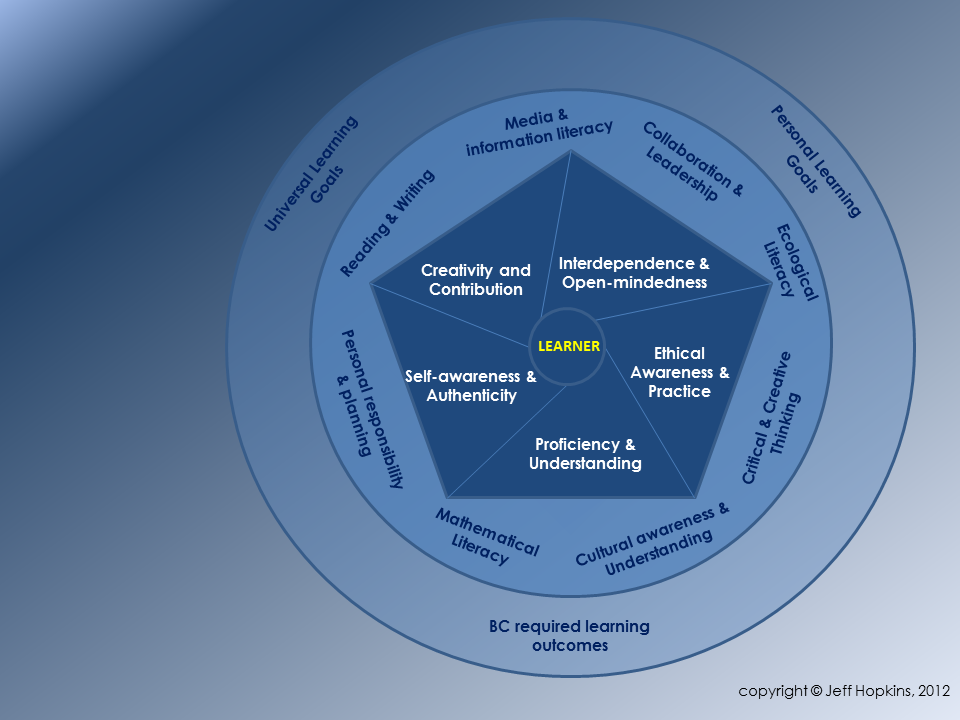
A screenshot of Trevor’s inquiry diagram from his website

I enjoyed Trevor’s presentation style and content. He provided the class with practical inquiry-based strategies to add to our teaching repertoire, and gave us realistic expectations for utilizing his ideas in the classroom.

Reflection 2: Students and Cellphones in School

On Tuesday, September 24,

educational consultant Jesse Miller spoke to our EDCI 336 class about “personal mobile technology” in the classroom, corresponding regulations, and personal boundaries as a professional in an education setting.

Miller argues that the current methodology to curbing phone usage in class is not preparing students for reality. He further asserts that by banning cellphones in class, parents and administration are expecting students to grow up in the low-tech reality that previous generations grew up in. The solution to this problem is to educate children to help them understand the things that they are experiencing online, teaching them “enduring values,” and empowering their communication.

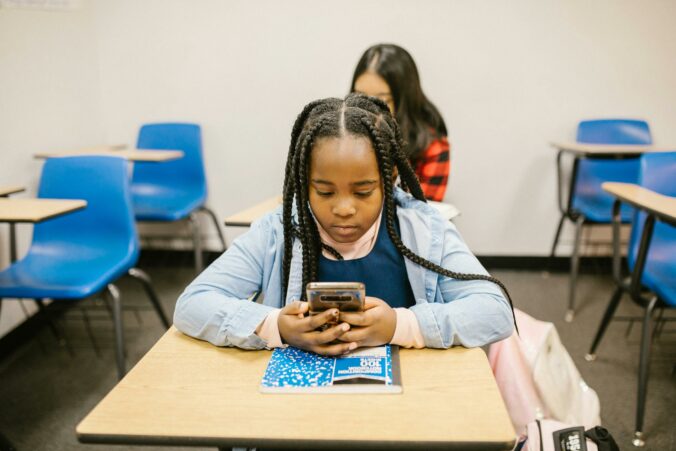
Photo by Pixabay: https://www.pexels.com/photo/silver-ipad-on-white-book-page-289737/

Other topics, such as internet culture, digital identity/rights, educator responsibilities, sexual harassment, and communication, were enthusiastically discussed.

Jesse Millers website can be viewed here: https://www.mediatedreality.com/

Many students and adults have an unshakable urge to use social media (Watson, 2018)1. As educators, policymakers, and adults, we need to ensure the well-being of the children in our society. A part of this well-being is delivered through students learning the prescribed curriculum. According to a 2022 meta-analysis on social-media addiction conducted by Diego Calderón-Garrido2, there is an inverse relation between phone use and academic performance. 

Banning cellphones in school is likely not the most effective solution to the problem. Calderón-Garrido concluded that the uncontrollable urge to go on social media could be avoided if “there is sufficient emotional education and good development of media literacy.” He also posits that the “authoritarian and disciplinary style are negatively related to the problem of dependency.” So, while banning cellphones may have a positive impact on academic performance, there may be unintended consequences for the overall problematic cellphone use.

Calderón-Garrido and Miller would probably agree on this: Children need to be trained to have sufficient self-regulation and digital literacy skills before cell phones are introduced in the classroom.

Below is a great TEDxtalk on cell phone addiction, and some of the implications on mental health arenot talked about in this article.

A great TEDxTalk about cell phone addiction.
  1. Watson, J. C., Prosek, E. A., & Giordano, A. L. (2021). Distress among adolescents: An exploration of Mattering, social media addiction, and school connectedness. Journal of Psychoeducational Assessment, 40(1), 95–107. https://doi.org/10.1177/07342829211050536 ↩︎
  2. Calderón-Garrido, D., Ramos-Pardo, F. J., & Suárez-Guerrero, C. (2022). The use of mobile phones in classrooms: A systematic review. International Journal of Emerging Technologies in Learning (iJET), 17(06), 194–210. https://doi.org/10.3991/ijet.v17i06.29181
    ↩︎

Reflecting on Educators and FIPPA

In a lecture given by Dr. Michael Paskevicius in the course”Technology and Innovation in Education,” we discussed the Freedom of Information and Protection of Privacy Act (FIPPA) and its implications on the way educators interact on social media1.

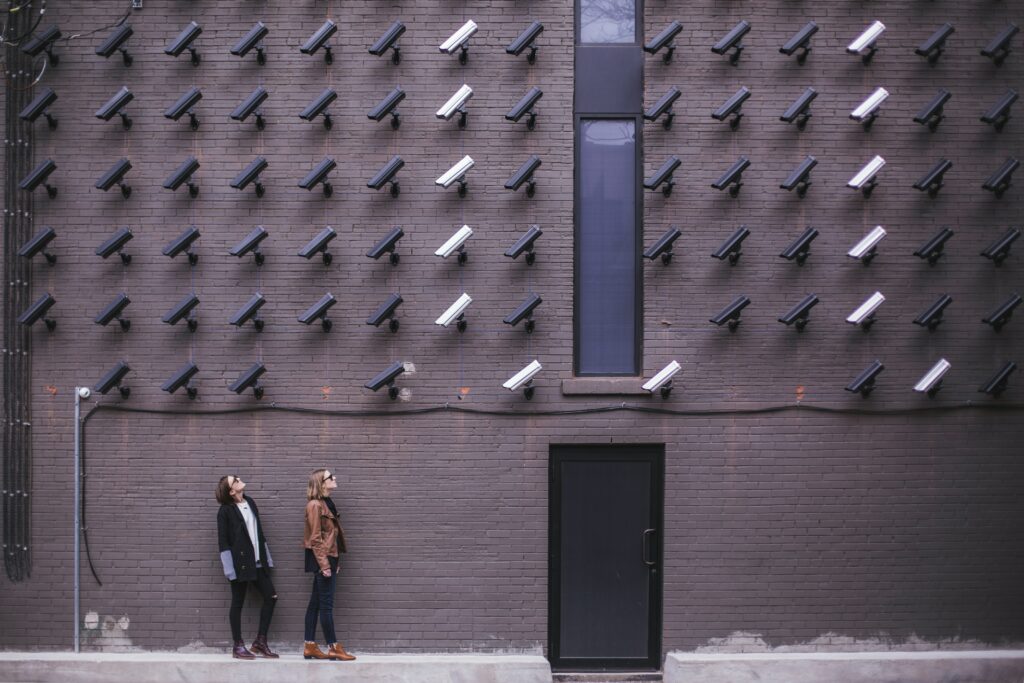
We live in a ‘datafied’ world. Why further expose students? Photo by Matthew Henry on Unsplash

Educators must be conscientious about where they record information about their students. Organizing grades on a Google slide might seem harmless, but a simple data leak or hacked Google account can leave the student’s information compromised.

Educators need to be aware of their actions on social media. Adding a pupil as a ‘friend’ can blur the boundary of the relationship between the student and teacher. This also puts both the student and teacher at risk, as an ‘off colour’ post can lead to awkwardness and discomfort for both parties.

Holy smokes! Did you see what Mr. Paskevicius posted online? Photo by Vanessa Loring Via Pexels

Even utilizing social media to engage students can be risky. Imagine a teacher has just set up an assignment where the students will make a TikTok video to demonstrate their learning. For the teacher to view the assignments, they must have some visibility to the students’s personal TikTok accounts. To the student, this could feel like an invasion of privacy. If a student doesn’t already have a TikTok, the teacher (in general) is required to receive permission from the student’s parents along with a notice of purpose. If the student does not want to join the social media, the teacher must provide an alternative to using the social media2.

It is important for educators to take the opportunity to educate students about privacy, datafication, and surveillance.

Dr. Michael Paskevicius, Slides from week two (link)

Personal data is the currency of big-tech companies3. As educators, parents, and knowledge holders, it is our duty to inform others about how our data is being used.

  1. Freedom of Information and Protection of Privacy Act (link) ↩︎
  2. Vancouver Island University has a great Privacy Guide (link) for educators using 3rd party web technology. ↩︎
  3. A ZDNet article on what Big Tech is doing with the data it collects (link) ↩︎
Newer posts »

© 2026 Mr. Spong's Blogs

Theme by Anders Noren — Up ↑