2026.10.06
Module 2 – Design and Inquiry Part 2
What is design thinking?
Design thinking is a framework to help define problems (Riddle, 2016). Design thinking has five main stages: empathize, define, ideate, prototype, and test.
Employing empathy allows a designer to take on a perspective that is other than their own (Riddle, 2016). By considering others’ perspectives, the designer can identify their needs and apply their knowledge to help.
Defining a problem is essential to designing technology and must be done by gathering input from those who are actually affected (Riddle, 2016). As Riddle (2016) states, “clearly defining the problem gives you a better chance at creating a clear solution.”
To ideate is to brainstorm, usually in team settings, to “generate as many solutions” as possible (Riddle, 2016). When brainstorming, it helps to consider all avenues, even those outside reasonable cost or labour limits. Sometimes the parts of these ideas can be distilled into something tangible.
Prototypes allow a product to be revised as new information emerges (Riddle, 2016). Revisions and iterations are most effective when opinions from multiple stakeholders are considered. Testing prototypes is essential to identify weak points and missed considerations.
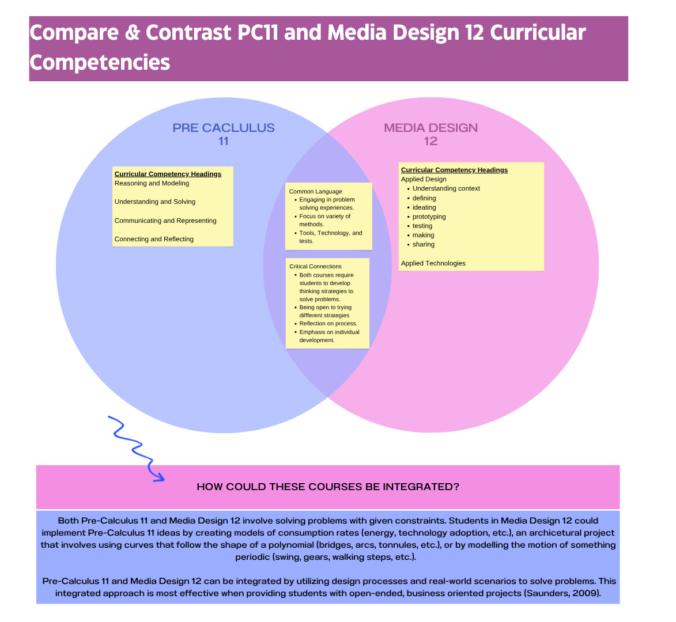
Using the design thinking process or elements of the design thinking framework to teach a concept in a senior-level Math or Science course.
In Physics 11, students are introduced to gravitational acceleration. The effects of gravity depend on an object’s mass, which differs across the planets and moons of our solar system. Design thinking could be used in a project where students design a landing apparatus for a space rover on a planet other than Earth. Students would consider the planet’s atmospheric and gravitational conditions. Students would then define the problem and identify constraints other than gravity, such as atmospheric conditions. Students would have to brainstorm different designs and consider costs, materials, and other logistics. Finally, students could develop prototypes using low-cost materials like cardboard.